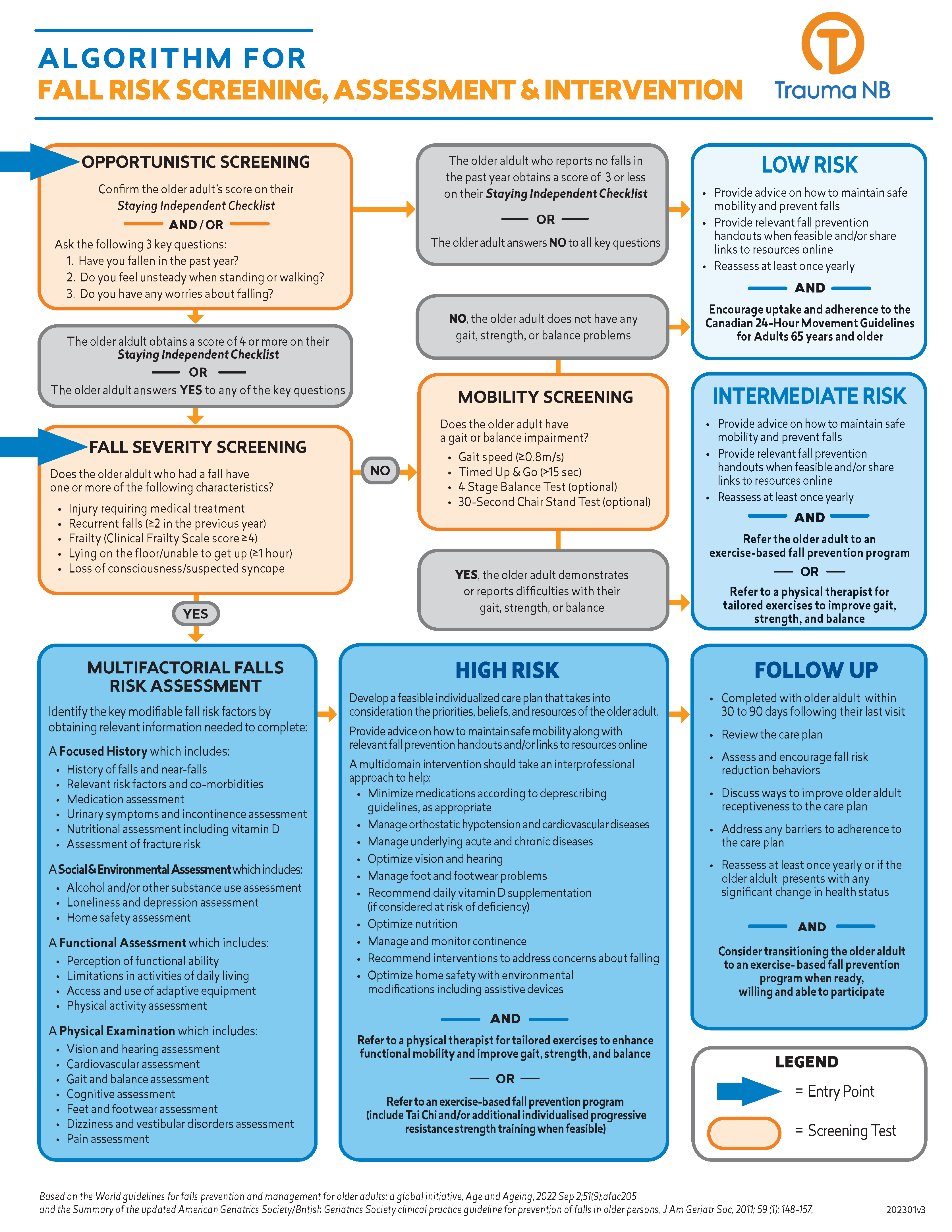
Fall Severity Screening
Fall Severity Screening happens immediately after a patient fails Opportunistic Screening, or can be employed as the first step of the Algorithm for Fall Risk Screening, Assessment & Intervention, rather than Opportunistic Screening, depending on the available information.
If a recent medical history of the patient is available, it may be clear that the patient will fail Opportunistic Screening by answering "no" to at least one of the three Key Questions.
For example, a patient is presenting for a follow-up appointment after a visit to the emergency department due to a fall. Here, there is a clear recent history of falls and it would be appropriate to skip Opportunistic Screening and begin with Fall Severity Screening.
CAUTION!
It would be inappropriate to skip Opportunistic Screening due to a recent medical history that does not include falls.
At least one form of screening should always take place, screening should never be skipped altogether.
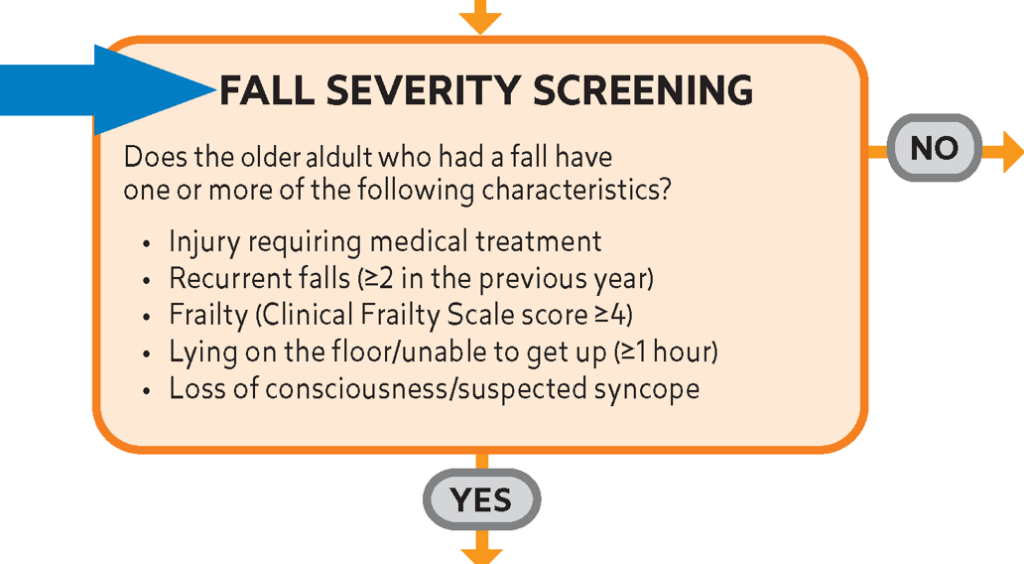
Fall Severity Screening:
There are five items in Fall Severity Screening:
- Injury requiring medical treatment.
- Recurrent falls (two or more in the previous year).
- Frailty (Clinical Frailty Scale score of four or more).
- Lying on the floor/unable to get up (more than one hour).
- Loss of consciousness/suspected syncope.
Failing Fall Severity Screening:
If at least one of the five items are true or the answer is "yes", the patient has failed Fall Severity Screening. The patient is considered at High Risk for falling and advances to the Multifactorial Fall Risk Assessment on the Algorithm for Fall Risk Screening, Assessment & Interventions.
The Multifactorial Fall Risk Assessment should be completed in partnership with other health care providers to identify key modifiable fall risk factors. The primary health care provider is responsible for leading this assessment and providing the appropriate referrals and follow-up appointments.
Passing Fall Severity Screening:
If all five items are false or all the answers are "no", the patient has passed Fall Severity Screening. Next, the patient advances to Mobility Screening.
The patient progresses to a secondary type of screening because they either failed Opportunistic Screening or have a recent medical history of falls. Therefore, further investigation is required to determine in the patient is at Low Risk or Intermediate Risk for falls.
ALL PATIENTS 65 YEARS OR OLDER SHOULD BE SCREENED FOR RISK OF FALLING EACH YEAR.
Full Algorithm: